Do LLMs Know What a Pun Is?
Research question: Do large language models know what a pun is? How do they represent that awareness? And does pun awareness play any role beyond forming a joke to make people laugh?
This project is a research demo developed as part of Neural Mechanics, a course on understanding the internal mechanisms of neural networks. The goal is to fully develop an example piece of new research using the methods of the class: creating datasets with large-scale LLMs, selecting target models, measuring model behavior, and isolating internal representations.
Why Puns?
Humor is not well-understood, and it’s fun to study. But puns are interesting for deeper reasons than entertainment.
A pun is a word that holds two meanings at the same time. “Battery” is both a criminal charge and an iPhone component. “Draft” is both an NBA selection and the start of a manuscript. This is a form of superposition in visible human vocabulary — a single token encoding two distinct concepts simultaneously.
This connects to one of the central phenomena we study in Neural Mechanics: the superposition hypothesis, where neural network features are packed into fewer dimensions than there are concepts to represent. Puns are a case where this sparse coding isn’t hidden inside activations — it’s right there in the words themselves. How deep does this visible superposition go? How difficult is it for models to wrestle with two meanings at once?
Humans find puns funny, especially kids, and we don’t fully understand why. What is the purpose of humor? One possibility is that the recognition of double meaning — the moment of seeing both readings at once — is itself the cognitive event that produces the feeling of humor. If so, then pun awareness in a language model might be more than a party trick. It might reflect something about how the model processes ambiguity, resolves polysemy, and represents the relationships between concepts.
So we want to isolate the processing of puns: see what triggers it, test whether we can suppress it, and ask what happens to the model when we do. Does pun awareness play any other role beyond forming a joke?
The Setup
Every pun has two readings: a straight (literal) meaning and a funny (double-meaning) interpretation. For example:
The dangerous iPhone was arrested and charged with ___
The straight completion is something like “assault” or “theft.” The pun completion is “battery” — which means both a criminal charge and an iPhone component.
If a language model “gets” the joke, it should be able to produce the pun word. And if the model has some internal representation of pun-awareness, we should be able to activate or suppress it by manipulating context.
Step 1: Building the Dataset
Scripts: datasets/rawdata/analyze_jokes.py,
datasets/rawdata/repair_jokes.py,
datasets/rawdata/apply_edits.py,
datasets/rawdata/build_puns_205.py
We started with a small seed of fill-in-the-blank pun sentences and used Claude, Gemini, and ChatGPT to expand the pool to ~1,000 candidate jokes. Each LLM was then used as a critic — rating every joke on a 0–10 scale for how well the pun works, with explanations of the double meaning.
The rating prompt asks models to act as comedy critics:
Rating guidelines: 8–10: Exceptional — surprising pun, tight double meaning, natural setup. 6–7: Good — solid pun with clear double meaning. 4–5: Average — predictable or forced. 2–3: Weak — double meaning is a stretch. 0–1: Bad — barely works.
Jokes scoring below 7.0 (averaging Gemini and Claude ratings) were sent back
to Claude for creative repair — fixing contradictory setups, forced phrasing,
and weak double meanings
(repair_jokes.py).
After automated repair, a final hand-editing pass polished the jokes:
fixing sentence wording, removing duplicates, and ensuring each pun lands
cleanly. The result is datasets/puns_205.json:
205 high-quality fill-in-the-blank pun sentences, each with curated
straight and punny completion lists.
See DATASET.md for full construction details.
Step 2: Measuring Model Performance
Scripts: datasets/annotate_completions.py,
analyze_baseline_performance.py
With 205 jokes in hand, we test five Llama models (3B to 405B parameters) on their ability to predict pun completions. For each joke, the sentence is truncated before the blank and sent to each model. We collect 20 diverse samples (temperature=0.8) plus 1 greedy sample (temperature=0) per model per joke — over 21,000 completions total.
Discovering Novel Completions
The models produce many completions beyond the ones we initially curated. A model might respond “bass” to a fish-and-guitar joke, or “fly” to a pilot joke — valid puns that weren’t in our original lists.
We handle this by sending all novel completion words to Claude for classification as straight (literal), funny (pun/wordplay), or other (doesn’t fit). This expands the straight and punny word lists for each joke, ensuring our measurements capture the full range of model creativity.
Baseline Results
Larger models produce pun completions more often, even without any special context:
| Model | Avg Funny Rate |
|---|---|
| Llama-3.2-3B | 16% |
| Llama-3.1-8B | 25% |
| Llama-3.1-70B | 36% |
| Llama-3.3-70B | 36% |
| Llama-3.1-405B | 41% |
But this average masks an important structure. We classify jokes into four tiers based on how models naturally split between straight and funny:
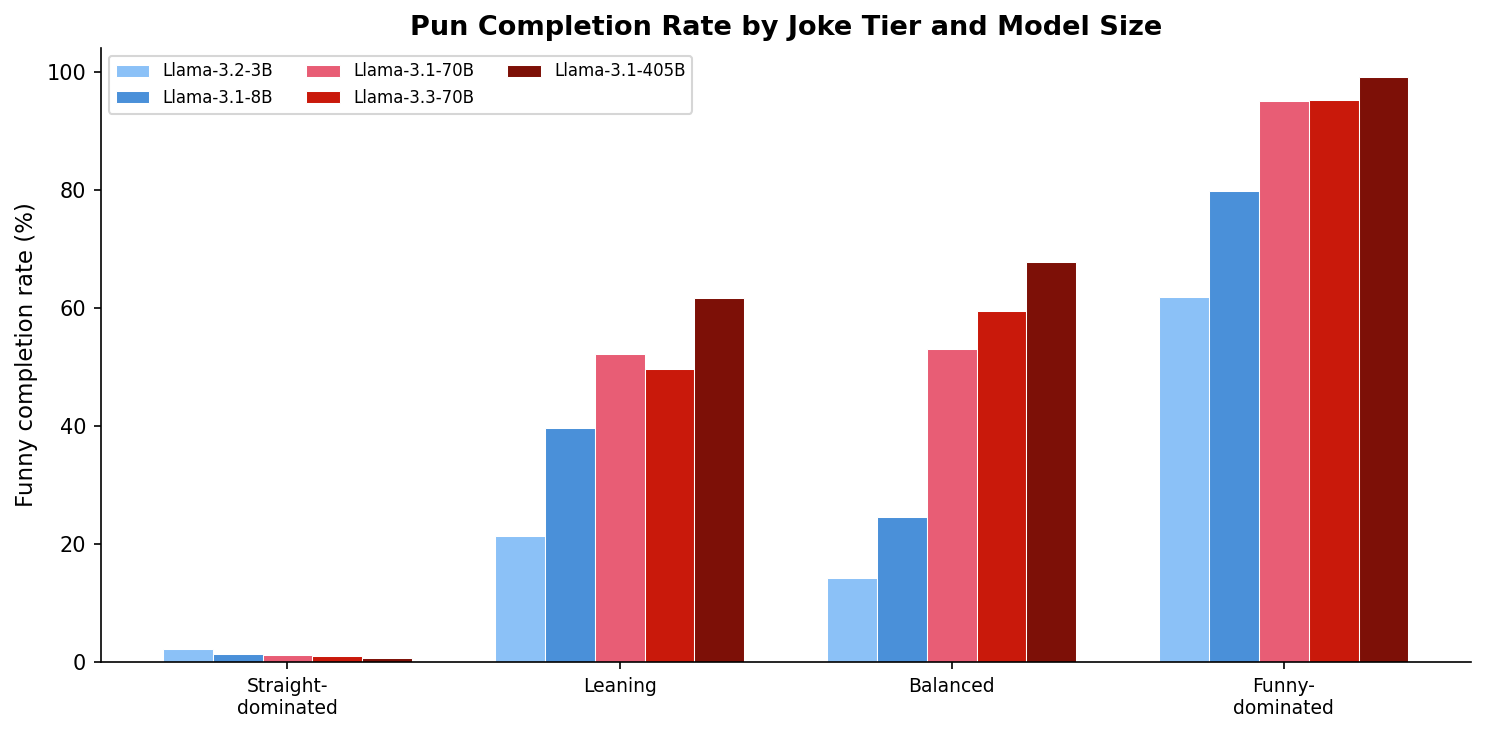
At one extreme, funny-dominated jokes (24 of 205) are puns that every model gets, even the smallest. These are jokes where the pun word is practically the only sensible completion:
The arctic navigator was great at parties because he knew how to break the ___ → “ice” (100% pun rate across all models)
In the balanced middle (42 jokes), models split between straight and funny completions, and size matters — bigger models get the joke more often:
The crab never shared his toys because he was ___ → “shellfish” (pun) vs. “greedy” (straight). The 3B and 8B models always say “greedy”; the 405B model says “shellfish” every time.
At the other extreme, straight-dominated jokes (88 of 205) have near-zero pun rates across all models — the pun is there, but no model recognizes it:
The tailor won his court case because he had an excellent ___ → “suit” (pun) vs. “lawyer” (straight). Every model at every size says “lawyer.” Zero pun completions.
These straight-dominated jokes become the key targets for the next step: can we make the model see the pun by manipulating context?
Step 3: Isolating Pun Awareness
Scripts: datasets/build_cloze_tests.py,
run_cloze_benchmark.py,
analyze_cloze_results.py
Beyond raw performance, we want to isolate pun awareness — the model’s ability to recognize and respond to a pun-inviting context.
The key insight is that each joke can be stated in two ways: a straight way that isn’t funny, and a punny way that is. Many of our jokes, seen in isolation, don’t seem like jokes at all — models naturally complete them with literal words. But what if we surround them with sentences that have already been completed as puns?
Contrastive Cloze Design
We select 50 straight-dominated jokes as targets — jokes where models default to the literal completion. Each target is paired with two context jokes that have clear straight/funny word pairs. This generates 100 test prompts: 50 with straight-primed context and 50 with funny-primed context.
For example, a funny-primed prompt might look like:
The dieter went to the paint store to get thinner. The two antennas met on a roof and the wedding had excellent reception. The dangerous iPhone was arrested and charged with
Results
The context effect scales monotonically with model size:
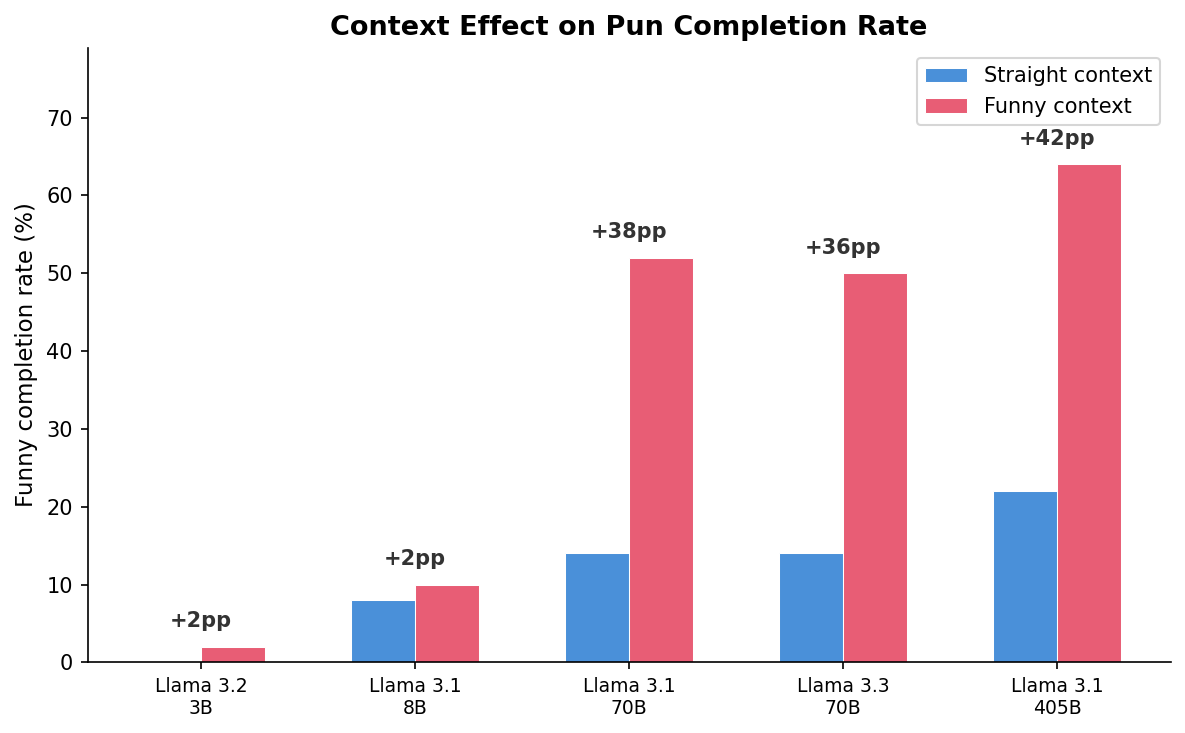
| Model | Straight ctx | Funny ctx | Delta |
|---|---|---|---|
| Llama-3.2-3B | 0% | 2% | +2pp |
| Llama-3.1-8B | 8% | 10% | +2pp |
| Llama-3.1-70B | 14% | 52% | +38pp |
| Llama-3.3-70B | 14% | 50% | +36pp |
| Llama-3.1-405B | 22% | 64% | +42pp |
Key findings:
-
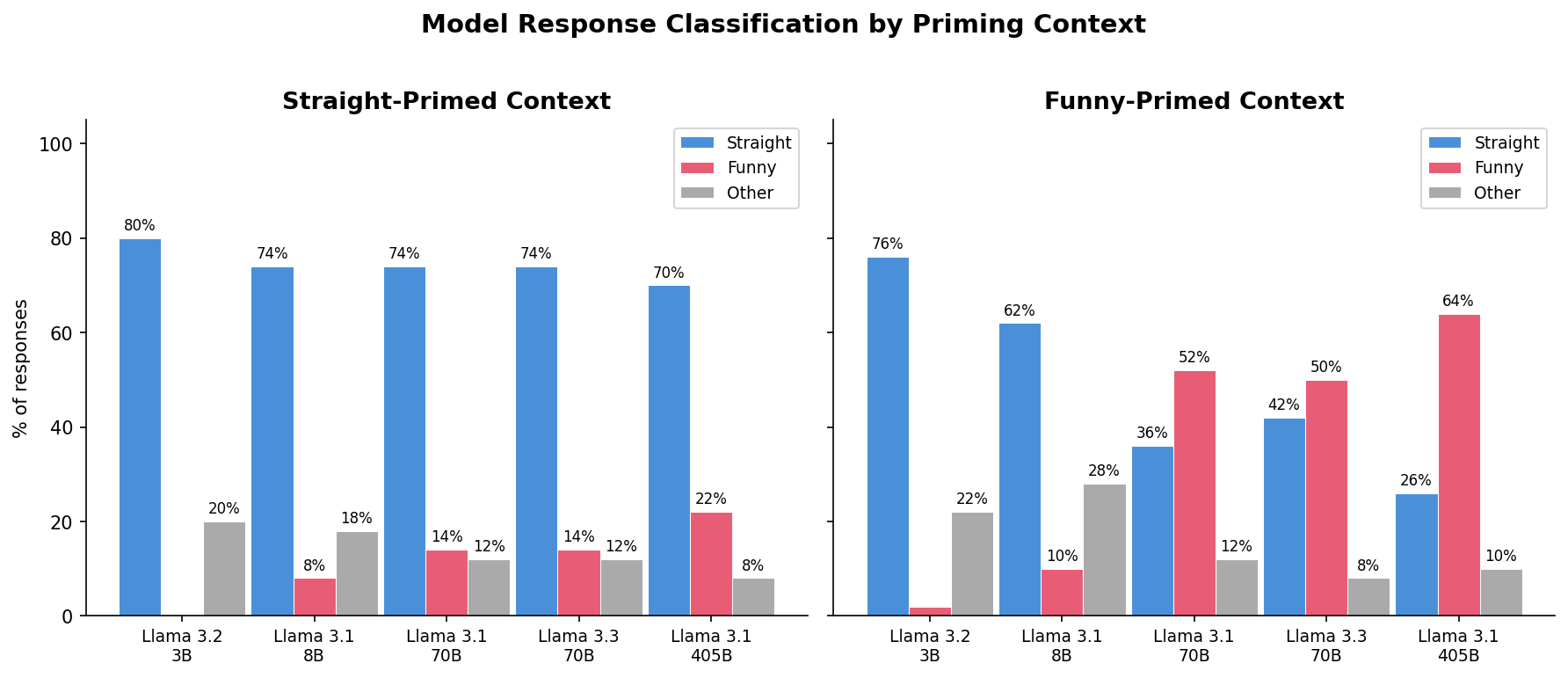
3B and 8B models are pun-blind. They produce almost no pun completions regardless of context (+2pp or less).
-
A phase transition occurs between 8B and 70B. The context effect jumps from +2pp to +38pp — a 19x increase. This suggests pun-in-context recognition requires a threshold level of model capacity.
-
70B+ models have latent pun awareness. They rarely produce puns in straight context (14–22%), but funny context reliably activates pun completions (50–64%). The 405B model shows the strongest effect: +42pp.
-
Straight completions are suppressed by funny context. For 70B+ models, straight rates drop from 70–74% to 26–42% — confirming the context manipulation genuinely shifts model behavior.
See EXPERIMENTS.md for full experimental details.
Next Steps
With behavioral evidence that 70B+ models have contextually-activated pun awareness, the next phase of this research will use the interpretability methods from Neural Mechanics to locate and understand the internal representations that drive this behavior:
- Where in the model does pun-awareness emerge? At what layer does the model begin to represent the double meaning?
- What internal features distinguish “pun mode” from “straight mode”? Is there a sparse feature or direction in activation space that encodes pun-awareness?
- Can we causally intervene to activate or suppress pun completion? If we clamp the pun-awareness feature off, does the model lose the ability to make jokes?
- Does pun awareness serve any other purpose? If we suppress the feature that drives pun completion, does the model also lose something else — the ability to process polysemy, to handle ambiguity, to reason about words with multiple meanings? Or is pun-awareness a narrow, isolated skill?
Project Structure
datasets/
  puns_205.json                    205 curated pun sentences
  contextual_cloze_tests_100.json  100 contrastive test prompts
  annotate_completions.py          Collect & classify model completions
  build_cloze_tests.py             Build contrastive test prompts
  rawdata/                         Early-phase scripts and data
    analyze_jokes.py               Multi-provider joke rating
    repair_jokes.py                Weak joke repair via Claude
    apply_edits.py                 Hand-edit application
    build_puns_205.py              Final dataset assembly

run_cloze_benchmark.py             API scraper for contrastive tests
analyze_cloze_results.py           Contrastive experiment analysis
analyze_baseline_performance.py    Baseline pun-rate analysis

results/
  cloze_benchmark_raw.json         Raw model responses
  cloze_analysis.json              Classified results
  figures/                         Generated plots
| Document | Contents |
|---|---|
| DATASET.md | Dataset construction pipeline |
| EXPERIMENTS.md | Experiment design and results |